
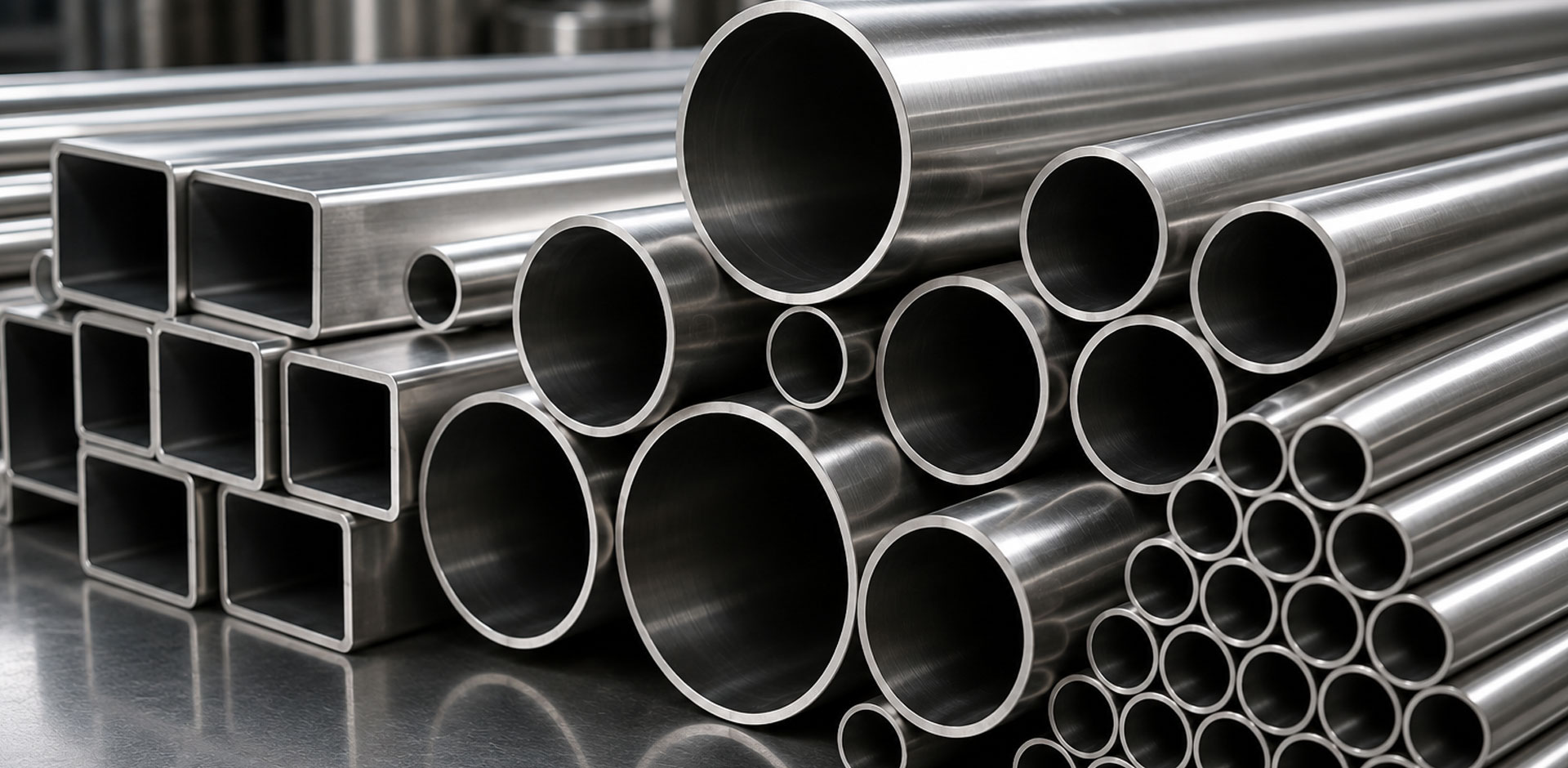
Seamless pipe has no longitudinal weld and no weld to inspect. Modern welded pipe is far closer in performance than its reputation suggests, and usually cheaper - until the joint efficiency factor enters the wall thickness calculation.
Seamless pipe starts as a solid round billet. The billet is heated, pierced over a mandrel to create a hollow, then elongated and sized by rolling or drawing. There is no join anywhere in the wall.
Welded pipe starts as flat strip or plate. The material is formed into a cylinder and the edges are joined along one longitudinal seam — by electric resistance welding (ERW / HFW), by submerged arc welding (LSAW or SSAW), or in older low-pressure product by furnace butt welding. The result is dimensionally identical to seamless pipe and, in a modern mill, metallurgically far closer than reputation suggests.
| Consideration | Seamless | Welded (ERW / LSAW) |
|---|---|---|
| Longitudinal weld | None | One (LSAW/ERW) or helical (SSAW) |
| Wall thickness uniformity | Eccentricity typical ±10–12.5% | Very uniform — inherits strip tolerance |
| Ovality and straightness | Good | Generally better |
| Practical size ceiling | Up to about NPS 24 | Effectively unlimited — LSAW to 60 inch and beyond |
| Cost per metre | Higher | Typically 15–30% lower |
| Lead time | Longer for special sizes | Shorter, strip is readily available |
| Weld joint efficiency (ASME B31.3) | 1.00 | 0.85 (ERW) to 1.00 (100% radiographed DSAW) |
| Sour service suitability | Preferred | Possible with qualified HIC-tested material |
| Cyclic / fatigue duty | Preferred | Seam is a stress concentration |
ASME B31.3 calculates required wall thickness using a longitudinal weld joint quality factor, E. Seamless pipe takes E = 1.00. Standard ERW pipe takes E = 0.85. Double submerged arc welded pipe with full radiography can reach 1.00, but only with that examination performed and documented.
The consequence is arithmetic: for the same design pressure, ERW pipe at E = 0.85 needs roughly 18% more wall than seamless. On a thin-wall utility line the extra wall is cheap and welded pipe still wins on total cost. On a heavy-wall high-pressure header, the extra wall can erase the price advantage entirely — and seamless becomes both simpler and cheaper.
Run the wall thickness calculation both ways before assuming welded pipe is the economical option. Above a certain pressure it stops being true.
Modern high-frequency ERW pipe is subject to continuous online eddy current or ultrasonic testing of the seam, post-weld seam normalising to restore the heat affected zone microstructure, hydrostatic testing of every length, and flattening tests with the weld positioned at both 6 and 12 o'clock. Where those controls are in place and documented, the seam is not a weak point in any meaningful sense.
What to insist on when buying welded pipe for pressure service: confirmation of the seam NDT method and coverage, evidence of seam heat treatment, the hydrostatic test pressure, and the joint efficiency factor the mill certifies. If any of these is vague, treat the material as suitable for structural duty only.
Furnace butt welded pipe (ASTM A53 Type F) is a legacy product made by continuous forming and pressure welding without filler. It is inexpensive and entirely adequate for low-pressure water and air, but it should never be considered for process, pressure or elevated-temperature service. Many specifications explicitly exclude it, and rightly so.
Specification and grade, seamless or welded (and if welded, which process), NPS and schedule or the actual OD and wall, length requirement, end finish, the joint efficiency your design assumed, any NDT or hydrostatic test requirement, and the certification type. Stating the joint efficiency up front prevents a mismatch between what your calculation assumed and what the mill certifies.
Custom fabrication, special sizes and complete export documentation are handled in house. Send us your drawing or specification and our technical team will come back with a detailed offer, usually within one working day.